


Recently viewed products
Renaissance and Medieval Footwear
The right footwear is the finishing touch on any medieval or Renaissance kit. This page covers our full range of historically accurate leather shoes and boots, from practical medieval ankle boots and laced calf shoes through to the wide-toed Landsknecht shoes of the Renaissance. Browse by period below.
What Did Medieval and Renaissance People Actually Wear on Their Feet?
Leather was the standard material for footwear across the full medieval and Renaissance period, used by every social class. What varied was the quality of the leather, the construction, and the style, all of which signaled rank and status in ways that were sometimes legally enforced. In several countries, sumptuary laws dictated the length of shoe toe a person could wear based on their social standing. Nobility were permitted extravagantly long points; peasants were not.
The dominant construction method throughout the medieval period was the turn shoe: a shoe sewn inside out and then turned for use, keeping the seams on the inside and away from moisture. It was simple, durable, and used consistently from the early medieval period through to the 16th century.
Medieval Shoes and Boots
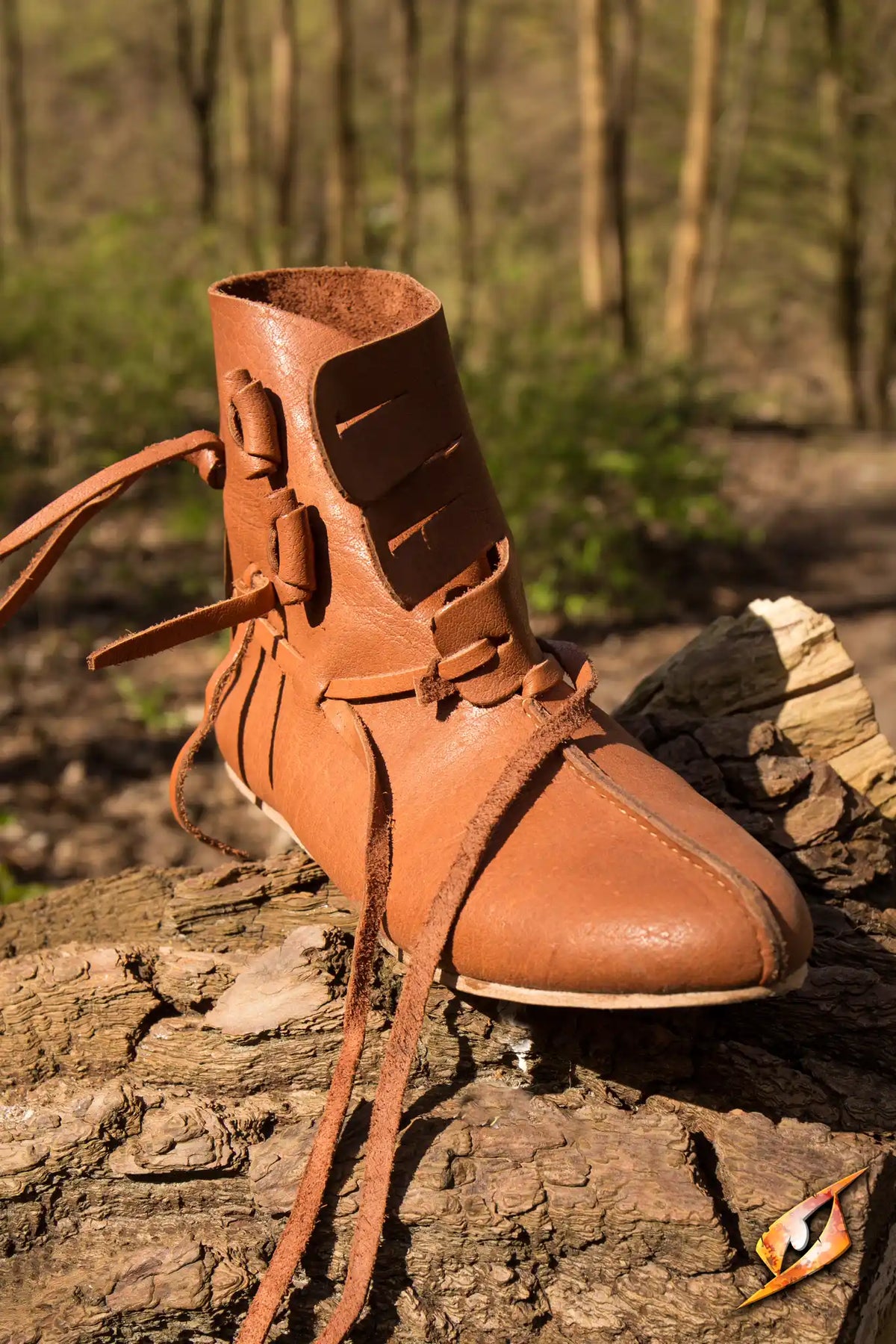
The medieval period produced a wide range of footwear styles, varying by century, region, and social class. For everyday practical wear, ankle boots and laced calf boots were the standard across most of the period. Close-fitting, laced up the front or side, and made from sturdy leather, they worked for everything from field work to courtly dress depending on the quality of the leather.
For the upper classes, the poulaine was the defining style of the 14th and 15th centuries. A low-cut leather shoe with a dramatically pointed toe, it was fashionable, impractical, and deliberately so. The longer the toe, the higher the status. At its most extreme, poulaine toes were stuffed and tied to the knee to keep them from dragging on the ground. By the 1480s the style had fallen out of fashion entirely, replaced by something altogether different.
Our medieval range includes laced calf boots suited to a broad range of 13th to 15th century impressions, as well as shoes suited to both practical and courtly medieval dress.
Landsknecht and Renaissance Footwear
When the poulaine fell from fashion in the late 15th century, it was replaced by its opposite: the wide, square-toed shoe known variously as the Landsknecht shoe, Tudor shoe, cow-mouth shoe, duckbill shoe, or bear paw. The names give a good sense of the silhouette.
The style originated with Swiss and German mercenary infantry, the Landsknechts, in the 1480s, and spread rapidly across Europe as a mainstream fashion for men and women from roughly 1480 to 1540. It crossed class boundaries quickly, worn by soldiers, merchants, and nobility alike. Typically made from leather with a buckle closure, the wide toe was sometimes slashed or cut to show contrasting fabric beneath, a decorative detail common in Landsknecht dress more broadly.
If you are building a late 15th or early 16th century impression, a Landsknecht shoe is the period-correct choice and one of the most recognizable silhouettes of the Renaissance.
How to Choose the Right Pair
Match your shoes to your period. Laced calf boots and ankle boots suit most 13th to 15th century impressions. Landsknecht shoes are correct from the late 15th century onward into the early 16th. If you are unsure, check the product descriptions for the specific period each design references.
Think about your event. Leather soles are the most historically accurate but can be slippery on smooth surfaces. For outdoor events on grass or uneven ground, a rubber or crepe sole addition is worth considering. Check the product pages for sole options.
Sizing. Leather stretches and molds to the foot over time. If you are between sizes, sizing down is generally the better call for a snug fit that will break in comfortably.
Frequently Asked Questions
What is a turn shoe? A turn shoe is made inside out and then flipped for use, keeping the seams on the inside of the shoe away from moisture and wear. It was the standard construction method for medieval footwear from the early medieval period through to the 16th century.
What are Landsknecht shoes? Wide, square-toed leather shoes worn from roughly 1480 to 1540, first by Swiss and German mercenaries and then widely across Europe. Also called Tudor shoes, cow-mouth shoes, duckbill shoes, or bear paws.
What is a poulaine? A low-cut medieval shoe with an extremely pointed toe, fashionable among the European nobility from the mid-14th century through to the 1480s. The length of the toe was sometimes restricted by sumptuary law based on social rank.
What footwear works best for outdoor events? Any of our leather shoes and boots will hold up well outdoors. For full-day events on grass or rough ground, consider a rubber or crepe sole option where available. Check individual product pages for details.
Are these suitable for SCA and LARP? Yes. All our footwear is built for wear, not just display, and is well suited to full-day events.